Friday, November 1, 2019

How a Bill Becomes a Law

Announcements:
READING: 325-331 in Edwards

UNIT TWO IDENTIFICATION TERMS

How a Bill Becomes A Law Google Doc
________________________________________________

Today's Essential Question: How do the differences between the House and Senate affect the lawmaking process?

Learning Standards:
CON-3.B: Explain how the structure, powers, and functions of both houses of Congress affect the policymaking process.
CON-3.B.2: Though both chambers rely on committees to conduct hearings and debate bills under consideration, different constitutional responsibilities of the House and Senate affect the policy-making process.
CON-3.B.3: Chamber-specific procedures, rules, and roles that impact the policy-making process include:
  • Number of chamber and debate rules that set the bar high for building majority support
  • Roles of Speaker of the House, President of the Senate, party leadership, and committee leadership in both chambers
  • Filibuster and cloture
  • Holds and unanimous consent in the Senate
  • Role of Rules Committee, Committee of the Whole, and discharge petitions in the House
  • Treaty ratification and confirmation role of the Senate
CON-3.B.5: Pork barrel legislation and logrolling affect lawmaking in both chambers.

How a Bill Becomes a Law


The legislative branch is responsible for making the laws. However, that process is cumbersome and complex, designed to make the passage of bills difficult. Today we will look at the process of how a bill becomes a law.


1. Discuss the following quote:
"Laws are like sausages, it is better not to see them being made." -Otto von Bismarck

2. Look at the following chart. What conclusions can you make from the information? What explanations are there for the low number of bills being passed in recent years?


3. Read the following selection on how legislation is made.  As you read, take notes on the process. Specifically, contrast the classical way of legislation to the modern changes that have taken place over the last several decades.

4. This page lists all of the presidents and their vetoes. How frequently is the veto used? How successful are attempts to override vetoes? Which president had the most vetoes? Most vetoes overridden?


5. One unique rule of the Senate is the use of the filibuster, a tactic used to stall or block passage of a bill. Typically employed by the minority party, Senate rules allow for unlimited debate which means that a senator (or more likely a group of senators) can talk a bill to death.

Should we keep the filibuster? Read the two articles below about the use of the filibuster. Make a copy of this document and take notes on the readings, recording arguments both for the use and elimination of the filibuster. Finally, after evaluating the arguments explain your position on the use of the filibuster by the Senate.

Is the Filibuster a Drag on Democracy?

Fix the Filibuster, Don't Destroy It


Additional Readings:

US Constitution.net: How a Bill Becomes a Law

Project Vote Smart: How a Bill Becomes a Law


Videos:


Thursday, October 31, 2019

Congressional Powers

Announcements:
READING: 309-325 in Edwards
UNIT TWO IDENTIFICATION TERMS
________________________________________________

Today's Essential Question: How do the enumerated and implied powers of Congress impact the policymaking process?


Learning Standards:

  • CON-3.A: Describe the different structures, powers, and functions of each house of Congress.
  • CON-3.A.4: The enumerated and implied powers in the Constitution allow the creation of public policy by Congress, which includes:
    • Passing a federal budget, raising revenue, and coining money, declaring war and maintaining the armed forces
    • Enacting legislation that addresses a wide range of economic, environmental, and social issues based on the Necessary and Proper Clause

Congressional Powers
Most of the powers of Congress are found in Article 1, Section 8. Today we will classify the various powers of Congress and review/define several terms associated with Congressional powers.

1. DEFINE
  • enumerated (expressed) powers
  • implied powers
  • necessary and proper clause (elastic clause)
2. APPLY 
For each of the following, decide first if Congress has the power (either enumerated or implied). If they do have the power, is it enumerated or implied? What specific clause gives them that power? Remember, all implied powers still have to be connected to an enumerated power.
  1. prohibit sending weapons through the mail
  2. establish the Federal Reserve System (national bank system)
  3. institute a draft
  4. nominate a judge
  5. place a tax on alcohol
  6. establish a minimum wage
  7. create the IRS
  8. fire the Secretary of Defense
  9. issue US savings bonds
  10. ban discrimination in the workplace
  11. grant citizenship to "Dreamers"
  12. create a 40 hour work week


CLASSIFY: Create a 4 box grid (or other organizational chart like 4 columns) and classify the enumerated powers of Congress according to the following categories:
  • economic
  • military/foreign
  • other (ex. weights & measures)
  • non-legislative (ex. impeachment)
You should have a minimum of 3-4 items for each category.

Additional Readings & Videos:
Congressional Power (ThisNation.com)
Powers of Congress (USHistory.org)
Explanation of Enumerated Powers (Constitution Center)


Tuesday, October 29, 2019

Gerrymandering and the Supreme Court

Announcements:
READING: 309-325 in Edwards
________________________________________________

Today's Essential Question: What is the political impact that reapportionment, redistricting, and gerrymandering have on Congressional elections and policymaking?

Learning Standards:
  • CON-3.C: Explain how congressional behavior is influenced by election processes, partisanship, and divided government.
  • CON-3.C.1: Congressional behavior and governing effectiveness are influenced by: 
    • Ideological divisions within Congress that can lead to gridlock or create the need for negotiation and compromise 
    • Gerrymanderingredistricting, and unequal representation of constituencies have been partially addressed by such Court decisions as Baker v. Carr (1961), which opened the door to equal protection challenges to redistricting and stated the “one person, one vote” doctrine, and the no-racial gerrymandering decision in Shaw v. Reno (1993) 
Gerrymandering is when congressional districts are drawn in a such a way as to gain a political (partisan) advantage, sometimes resulting in oddly-shaped districts.

The original gerrymander:
 More recent examples of gerrymandering.


America's Most Gerrymandered Districts

There are multiple constitutional questions when it comes to redistricting and gerrymandering and the Court has had to deal with some of these issues over the past half-century. 

Q1: Do congressional districts have to have an equal population?
A1: Baker v. Carr, 1962; Reynolds v. Sims, 1964Wesberry v. Sanders, 1964

Q2: Should congressional districts be based on total population, total citizens, total citizens of voting age, or total number of registered voters?
Please read this article to help understand these questions.
A2: Evenwel v. Abbott, 2016

Q3: Does the creation of majority-minority districts (racial gerrymandering) help or hinder minority groups? Is it constitutional?
A3: Shaw v. Reno (Supreme Court Case Template)


Q4: Should partisan gerrymandering be abolished? Should it be left to independent, non-partisan commissions?
A4: Please read this article to look at the arguments on this question.


The Pennsylvania Supreme Court recently struck down its state's congressional districts arguing that partisan gerrymandering was unconstitutional.


Yesterday, we learned about how elected officials will often draw districts (redistricting) in a partisan manner, commonly referred to as gerrymandering. Today you will have the opportunity to put your gerrymandering skills to the test.


Task #1: Gerrymandering (paper activity)
1. Write your name and political party (either Stellar or Galaxy) at the top of the page.
2. Your task is to create ten districts.
3. Each district must have exactly ten dots, no more, no less.
4. Try to have your party be the majority in as many districts as possible through gerrymandering.Your goal is to gerrymander the state so you end up with eight of the ten districts in your favor. Keep trying until you are successful.
5. Label each district with either an S or G, depending on what party has a majority.
6. Districts must be contiguous.
7. All dots and spaces must be in a district.
Tip: Use a pencil!


Task #2: Gerrymandering--The Redistricting Game
1. Go to the Redistricting Game website.
2. Click "Play the Game"
3. Start with Mission Two (either Basic or Advanced) Partisan Gerrymander
4. Your goal is to create three districts (out of four) that favor your political party.
5. Remember to keep the population in each district relatively equal.
6. Once you successfully complete that mission, try Mission Four. This mission requires you to not only gerrymander based on party, but also includes racial/ethnic considerations in trying to create a majority-minority district.


Videos for Review:


Monday, October 28, 2019

Reapportionment, Redistricting, and Gerrymandering

Announcements:
QUIZ over House & Senate differences today!
READING: 309-325 in Edwards
UNIT TWO IDENTIFICATION TERMS
________________________________________________

Today's Essential Question: What is the political impact that reapportionment, redistricting, and gerrymandering have on Congressional elections and policymaking?

Learning Standards:
  • CON-3.C: Explain how congressional behavior is influenced by election processes, partisanship, and divided government.
  • CON-3.C.1: Congressional behavior and governing effectiveness are influenced by: 
    • Ideological divisions within Congress that can lead to gridlock or create the need for negotiation and compromise 
    • Gerrymandering, redistricting, and unequal representation of constituencies have been partially addressed by such Court decisions as Baker v. Carr (1961), which opened the door to equal protection challenges to redistricting and stated the “one person, one vote” doctrine, and the no-racial gerrymandering decision in Shaw v. Reno (1993) 
________________________________________________

Reapportionment, Redistricting, and Gerrymandering

Typically, we think that the voters are the ones that choose our elected officials. But, in actuality, it is the elected officials who are often the ones choosing the voters through a process known as gerrymandering. Over the next couple of days, we are going to take a look at reapportionment, redistricting, and gerrymandering.

What do you notice different about these two maps?

2002-2012 Missouri Congressional Districts


2012-2022 Missouri Congressional Districts


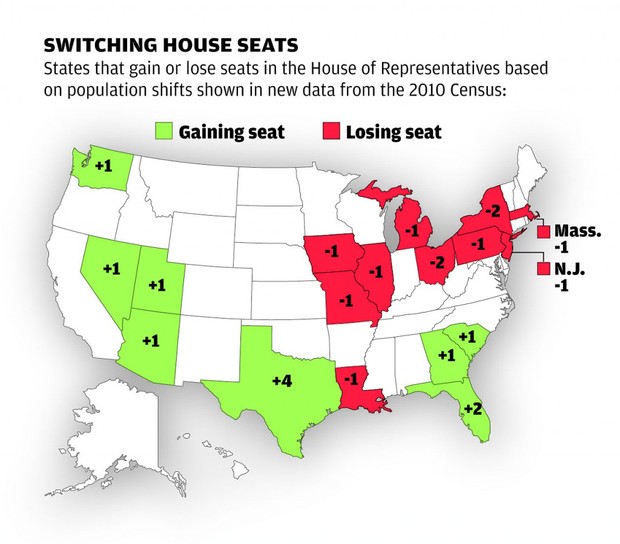
How did the 2010 Census impact Missouri's Congressional districts?

Reapportionment: the redistribution of Congressional seats (districts) based on the US Census results every ten years


Which states are expected to gain seats/lose seats after the 2020 census?

Redistricting: The redrawing of Congressional districts every ten years (typically by state legislatures). Redistricting plans must follow certain federal guidelines, including relatively equal population, as well as consideration of race and ethnicity-no "packing or cracking".

One major Supreme Court case, Baker v. Carr (1961) dealt with the redistricting issue and whether the Court could rule on the question of whether districts had to be of relatively equal populations. Use the Street Law summary of Baker v. Carr to fill out the Supreme Court Case template.

Read the following articles to find out more about redistricting.

US Census Apportionment Video

Tuesday, October 22, 2019

House vs. Senate (2 days)

Announcements:
QUIZ over House & Senate differences on Thursday
READING: 309-325 in Edwards
UNIT TWO IDENTIFICATION TERMS
________________________________________________
Today's Essential Question: How do the House and Senate differ and how do those differences impact the two bodies and the policymaking process?

Learning Standards:
CON-3.A: Describe the different structures, powers, and functions of each house of Congress.


CON-3.A.2: Different chamber sizes and constituencies influence formality of debate.

CON-3.A.1: The Senate is designed to represent states equally, while the House is designed to represent the population.

CON-3.A.3: Coalitions in Congress are affected by term-length differences.

CON-3.B: Explain how the structure, powers, and functions of both houses of Congress affect the policymaking process. 
CON-3.B.1: By design, the different structures, powers, and functions of the U.S. Senate and House of Representatives affect the policy-making process. 


House vs. Senate
The United States has a bicameral, or two-chambered, Congress. As part of the Great Compromise, it consists of both a House of Representatives and a Senate. Today we will be looking at the specifics of each chamber and how they are different.


1. Use the videos and links below to learn about the differences between the two chambers. Click on the above link for a listing of descriptions and characteristics of the House and Senate. In your group, make a two column chart ( House vs. Senate) in your notes and correctly place each term/characteristic in the appropriate column.

2. The differences between the House and Senate also create substantial differences in how they operate and address various policy issues. Make a copy of the linked worksheet and explain how those differences impact their approach to policy-making.


Khan Academy: The Senate and the House of Representatives

Difference Between: House v. Senate

Schmoop.com: pages on the House and the Senate


Diffen.com: House and Senate

Key Differences


Tuesday, October 15, 2019

The Supreme Court & Federalism

ANNOUNCEMENTS:
Read: 68-78 in Edwards
Unit 1 Identification Terms
Unit 1 Exam: Monday, October 21
Study the Unit 1 Standards
Unit 1 Standards-Student Questions Review
5th Hour Survey: Complete this survey to be eligible to win a class pizza party! Seniors--use this link instead.


_________________________________________________________________
Learning Objectives:
CON-2.B: Explain how the appropriate balance of power between national and state governments has been interpreted differently over time.
CON-2.B.2: The balance of power between the national and state governments has changed over time based on U.S. Supreme Court interpretation of such cases as:
  • McCulloch v. Maryland (1819), which declared that Congress has implied powers necessary to implement its enumerated powers and established supremacy of the U.S. Constitution and federal laws over state laws
  • United States v. Lopez (1995), which ruled that Congress may not use the commerce clause to make possession of a gun in a school zone a federal crime, introducing a new phase of federalism that recognized the importance of state sovereignty and local control


The Supreme Court and Federalism
The Supreme Court has decided many cases dealing with issues of federalism. Two of the most important cases are McCulloch v. Maryland and US v. Lopez. Today, we will look at these two cases and several others to see how the Court's rulings have impacted state-national relations.

***SCOTUS CASE TEMPLATE***
The College Board has identified 15 Supreme Court cases that are MUST-KNOWS. For each of these cases, you will make a copy of the SCOTUS Case Template and fill in the necessary information. Create a folder in your Google Drive:APGOV:SCOTUS Cases. Save a copy of the template and all 15 cases that we cover throughout the year here.

For each case, I have created a list of resources, both print and video for you to review and utilize to fill out the template. The Street Law and Oyez resources will be your best bets. Please make two copies of the template, one for McCulloch v. Maryland and one for US v. Lopez, use the resources provided and fill out each form.

McCulloch v. Maryland


MCCULLOCH V. MARYLAND DISCUSSION QUESTIONS
  1. What are the two central questions raised by this case?
  1. How does the Court answer these two questions?  What rationale (constitutional clauses) does the Court use to explain its decision?
  1. Compare the Court’s reasoning with the concerns raised by Brutus regarding the power of the government.


  1. How would our nation be different today if the Court had decided differently?


US v. Lopez (PBS Landmark Cases)

US v. Lopez (Bill of Rights Institute)

DAY TWO (Wednesday, Oct. 16)
Yesterday, we looked at two important cases involving federalism. It is imperative that you understand the importance of both McCulloch v. Maryland and US v. Lopez. However, it is also vital that you understand the role of federalism and the constitutional issues involved in a variety of questions and court cases.

Today, you will look at other Supreme Court cases that are questions of federalism and the role of the national government vs. the power of the states. Make a copy of this chart and fill out the information based on the above case summaries. Have this completed and ready to discuss for tomorrow. Use your class time wisely! Finish early? Study for your Unit 1 exam.


Videos for Review:


Friday, October 11, 2019

Fiscal or Regulatory Federalism

ANNOUNCEMENTS:
Read: 68-78 in Edwards
Unit 1 Identification Terms
Unit 1 Exam: Monday, October 21
5th Hour Survey: Complete this survey to be eligible to win a class pizza party! Seniors--use this link instead.
_________________________________________________________________
Learning Objectives:
CON-2.A: Explain how societal needs affect the constitutional allocation of power between the national and state governments.
CON-2.A.2: The distribution of power between federal and state governments to meet the needs of society changes, as reflected by grants, incentives, and aid programs, including federal revenue sharing, mandates, categorical grants, and block grants

Fiscal Federalism
One relationship that has dramatically changed over the past century is the redistribution of money from the federal government to the states. Typically, this transfer of money is through either the use of block grants or categorical grants. Today, we will take a look at the differences between the two and the impact on federal control and regulations.

Read the following Congressional Budget Report on Federal grants.

It's a fairly long document (30 pages), so we will divide and conquer. Get in groups of 4 and number off. Read the following sections:
Everyone: Summary pgs. 1-3
#1 Federal Outlays 3-7
#2 Rationales 7-12
#3 Federal Controls 12-17
#4 Federal Influence & Implications 17-23

Take 10-15 minutes to read, taking notes over your section. After reading your section, each member needs to share and explain their section. Everyone should take notes on each section explained.  If you finish early, read through the powerpoint presentation below.


Videos for Review