Today's Essential Question: Why do members of Congress keep getting re-elected if they have such low approval ratings?
Learning Standards:
PRD-2.C: Explain how the different processes work in U.S. congressional elections.
PRD-2.C.1: The process and outcomes in U.S. Congressional elections are impacted by:
Incumbency advantage phenomenon
General (presidential and midterm) elections
Congressional Incumbency Advantage The approval rating for Congress is currently in the mid-teens. Despite this low number, most members of Congress (typically over 90%) will be re-elected next year. How is this possible?
What are two observations you can make from the data below?
Today's Essential Question: What is the political impact that reapportionment, redistricting, and gerrymandering have on Congressional elections and policymaking? Learning Standards:
CON-3.C: Explain how congressional behavior is influenced by election processes, partisanship, and divided government.
CON-3.C.1: Congressional behavior and governing effectiveness are influenced by:
Ideological divisions within Congress that can lead to gridlock or create the need for negotiation and compromise
Gerrymandering, redistricting, and unequal representation of constituencies have been partially addressed by such Court decisions as Baker v. Carr (1961), which opened the door to equal protection challenges to redistricting and stated the “one person, one vote” doctrine, and the no-racial gerrymandering decision in Shaw v. Reno (1993)
Gerrymandering is when congressional districts are drawn in a such a way as to gain a political (partisan) advantage, sometimes resulting in oddly-shaped districts.
There are multiple constitutional questions when it comes to redistricting and gerrymandering and the Court has had to deal with some of these issues over the past half-century. Q1: Do congressional districts have to have an equal population? A1: Baker v. Carr, 1962;Reynolds v. Sims, 1964; Wesberry v. Sanders, 1964
Q2: Should congressional districts be based on total population, total citizens, total citizens of voting age, or total number of registered voters? Please read this article to help understand these questions. A2: Evenwel v. Abbott, 2016
Q3: Does the creation of majority-minority districts (racial gerrymandering) help or hinder minority groups? Is it constitutional?
A3:Shaw v. Reno (Supreme Court Case Template)
Q4: Should partisan gerrymandering be abolished? Should it be left to independent, non-partisan commissions?
A4: Please read this article to look at the arguments on this question.
Yesterday, we learned about how elected officials will often draw districts (redistricting) in a partisan manner, commonly referred to as gerrymandering. Today you will have the opportunity to put your gerrymandering skills to the test.
Task #1: Gerrymandering (paper activity)
1. Write your name and political party (either Stellar or Galaxy) at the top of the page.
2. Your task is to create ten districts.
3. Each district must have exactly ten dots, no more, no less.
4. Try to have your party be the majority in as many districts as possible through gerrymandering.Your goal is to gerrymander the state so you end up with eight of the ten districts in your favor. Keep trying until you are successful.
5. Label each district with either an S or G, depending on what party has a majority.
6. Districts must be contiguous.
7. All dots and spaces must be in a district. Tip: Use a pencil!
Task #2: Gerrymandering--The Redistricting Game
1. Go to the Redistricting Game website.
2. Click "Play the Game"
3. Start with Mission Two (either Basic or Advanced) Partisan Gerrymander
4. Your goal is to create three districts (out of four) that favor your political party.
5. Remember to keep the population in each district relatively equal.
6. Once you successfully complete that mission, try Mission Four. This mission requires you to not only gerrymander based on party, but also includes racial/ethnic considerations in trying to create a majority-minority district.
Today's Essential Question: What is the political impact that reapportionment, redistricting, and gerrymandering have on Congressional elections and policymaking? Learning Standards:
CON-3.C: Explain how congressional behavior is influenced by election processes, partisanship, and divided government.
CON-3.C.1: Congressional behavior and governing effectiveness are influenced by:
Ideological divisions within Congress that can lead to gridlock or create the need for negotiation and compromise
Gerrymandering, redistricting, and unequal representation of constituencies have been partially addressed by such Court decisions as Baker v. Carr (1961), which opened the door to equal protection challenges to redistricting and stated the “one person, one vote” doctrine, and the no-racial gerrymandering decision in Shaw v. Reno (1993)
________________________________________________
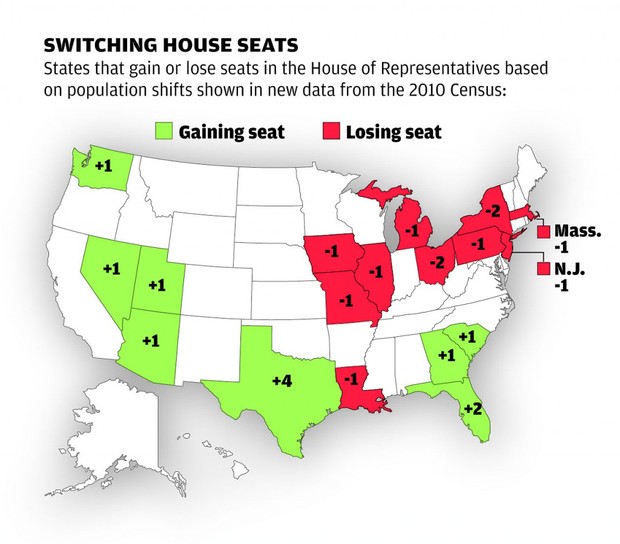
Reapportionment, Redistricting, and Gerrymandering
Typically, we think that the voters are the ones that choose our elected officials. But, in actuality, it is the elected officials who are often the ones choosing the voters through a process known as gerrymandering. Over the next couple of days, we are going to take a look at reapportionment, redistricting, and gerrymandering.
What do you notice different about these two maps?
Redistricting: The redrawing of Congressional districts every ten years (typically by state legislatures). Redistricting plans must follow certain federal guidelines, including relatively equal population, as well as consideration of race and ethnicity-no "packing or cracking".
One major Supreme Court case, Baker v. Carr (1961) dealt with the redistricting issue and whether the Court could rule on the question of whether districts had to be of relatively equal populations. Use the Street Law summary of Baker v. Carr to fill out the Supreme Court Case template.
Read the following articles to find out more about redistricting.