Showing posts with label civil liberties. Show all posts

Monday, April 20, 2020

The Right to Privacy

Announcements:
In addition to reading (and watching the screencast) today's post, please make sure you:
  1. Read the Street Law Summary on Roe v. Wade
  2. Fill in the information about this case on the Supreme Court case matrix (use the same copy you have been using)

READING: 85-126 in Edwards


Today's Question: How does the government effectively balance the right to privacy with the need to maintain order?


Learning Standards:
LOR-3.B.5: While a right to privacy is not explicitly named in the Constitution, the Supreme Court has interpreted the due process clause to protect the right of privacy from state infringement. This interpretation of the due process clause has been the subject of controversy, such as has resulted from:
  • Roe v. Wade (1973), which extended the right of privacy to a woman’s decision to have an abortion while recognizing compelling state interests in potential life and maternal health

Right to Privacy

Does the right to privacy exist? What amendment guarantees your right to privacy?

There are several important cases related to the issue of privacy rights and individual liberties. One of the most important cases is Griswold v. Connecticut (1965). In this case, Estelle Griswold of Planned Parenthood was prosecuted for distributing birth control pills, prohibited by Connecticut law, even to married couples. Click on the above link to read about the case. What is meant by penumbra?

Griswold is considered a landmark decision by establishing a right to privacy. This serves as a springboard to other privacy cases, most notably the case Roe v. Wade (1973) and other court decisions involving abortion rights and attempts to limit and regulate abortions. Read this summary of Roe v. Wade. Why is Roe v. Wade so significant? What did it specifically do?

Roe v. Wade was just the beginning of legal challenges concerning abortion. Since 1973, states have repeatedly passed legislation to limit abortions. The Court has maintained the right to an abortion, but has gradually upheld state and federal restrictions during the last forty years. Some of the restrictions include:

Missouri has one of the most restrictive abortion laws in the country, requiring a 72-hour waiting period.  Missouri has also increased its restrictive health regulations, threatening to shut down Missouri's only abortion provider (Planned Parenthood in St. Louis). Missouri would become the 1st state without any abortion access.

Can a state require abortion clinics to have surgical facilities and doctors with admitting privileges at local hospitals?


Other Privacy Issues

Forced sterilization: Buck v. Bell (1927) and Skinner v. Oklahoma

Right to Marry: Loving v. Virginia, 1967

Right to Die: Cruzan v. Missouri Dept. of Health, 1990

Sexual Behavior: Lawrence v. Texas, 2003

How do the Lawrence v. Texas and Loving v. Virginia cases affect the Supreme Court's decision regarding same-sex marriage?

Review Videos


Thursday, April 16, 2020

The 8th Amendment

Announcements:
In addition to reading today's post, please make sure you:
  1. Complete the assigned Khan Academy module on the 8th Amendment
  2. Complete the assigned Khan Academy Civil Liberties Quiz #2. Keep attempting until you score at least 80%!
  3. Study for Civil Liberties Amendments 2-8 Quiz on Friday

READING: 85-126 in Edwards


Today's Essential Question: Does the death penalty violate the 8th Amendment’s prohibition on cruel and unusual punishment?


Learning Standards:
LOR-2.D: Explain how the Supreme Court has attempted to balance claims of individual freedom with laws and enforcement procedures that promote public order and safety.

LOR-2.D.1: Court decisions defining cruel and unusual punishment involve interpretation of the Eighth Amendment and its application to state death penalty statutes over time. 

Eighth Amendment 

Two main provisions:
  • No cruel & unusual punishment
  • No excessive fines or bail
Most relevant issues involve use of the death penalty.

Furman v. Georgia, 1972: Death penalty was being unfairly applied (too random/arbitrary); puts a temporary moratorium on it

Gregg v. Georgia, 1976: reinstates the death penalty; provides more guidance to jurors

Other issues:
Death penalty for mentally challenged? Minors?


Review your civil liberties: Play the game Do I Have a Right  by iCivics. Pretend to be a lawyer and build up your law firm helping people with their complaints.

Review Videos:


Wednesday, April 15, 2020

3.8 Amendments: Due Process and the Rights of the Accused

Announcements:

Welcome to another week of online learning! It looks like the Missouri Constitution test was a success and you have cleared that hurdle towards graduation. This week, we will continue our examination of civil liberties, specifically looking at Amendments 2-8. Like past weeks, this will consist of daily posts, Khan Academy modules, videos, and multiple Supreme Court cases. You can find our weekly planner here. Remember that posts are in reverse order.

Please continue to stay on top of the content as all of this material is part of Unit 3 which will be tested on the AP exam on May 11th.

In addition to reading today's post, please make sure you:
  1. Read the Street Law summary on Gideon v. Wainwright (required case).
  2. Fill in the information about this case on the Supreme Court case matrix (use the same copy you have been using)
  3. Watch the Khan Academy videos on the 5th & 6th Amendments
  4. Complete the self-assessment on Rights of the Accused
  5. Google Meet Optional check-in to ask questions and clarify any concepts. Join either one of our meeting times at 10:30am or 1:00pm (see weekly planner for links)
READING: 85-126 in Edwards


Today's Essential Question: How does the government effectively balance the 5th and 6th Amendments’ rights of the accused with the need to maintain social order?


Learning Standards:
LOR-2.D: Explain how the Supreme Court has attempted to balance claims of individual freedom with laws and enforcement procedures that promote public order and safety.

LOR-3.B.2: The Miranda rule involves the interpretation and application of accused persons’ due process rights as protected by the Fifth and Sixth Amendments, yet the Supreme Court has sanctioned a public safety exception that allows unwarned interrogation to stand as direct evidence in court. 

LOR-3.B.3: Pretrial rights of the accused and the prohibition of unreasonable searches and seizures are intended to ensure that citizen liberties are not eclipsed by the need for social order and security, including: 
  1. The right to legal counsel, a speedy and public trial, and an impartial jury 
  2. Protection against warrantless searches of cell phone data under the Fourth Amendment 
  3. Limitations placed on bulk collection of telecommunication metadata (Patriot and USA Freedom Acts)

LOR-3.B.4: The due process clause has been applied to guarantee the right to an attorney and protection from unreasonable searches and seizures, as represented by: 
  1. Gideon v. Wainwright (1963), which guaranteed the right to an attorney for the poor or indigent 
  2. The exclusionary rule, which stipulates that evidence illegally seized by law enforcement officers in violation of the suspect’s Fourth Amendment right to be free from unreasonable searches and seizures cannot be used against that suspect in criminal prosecution

Rights of the Accused

Similar to the 4th Amendment and the protection of unwarranted searches, the government must balance the rights of the individuals and those accused of a crime with the need to maintain order and promote public safety. The various rights expressed in both the 5th and 6th Amendments were seen as essential in the early days of the republic and were rooted in grievances against prior English practices. In the 20th century, many of these rights were incorporated at the state level through a series of court decisions, most notably Gideon v. Wainwright and Miranda v. Arizona.


Review Videos:


Monday, April 13, 2020

3.6 Amendments: Balancing Individual Freedom with Public Order and Safety

Announcements:

Welcome to another week of online learning! It looks like the Missouri Constitution test was a success and you have cleared that hurdle towards graduation. This week, we will continue our examination of civil liberties, specifically looking at Amendments 2-8. Like past weeks, this will consist of daily posts, Khan Academy modules, videos, and multiple Supreme Court cases. You can find our weekly planner here. Remember, posts are reverse ordered, so you may have to scroll to find Monday's, Tuesday's, etc.


Please continue to stay on top of the content as all of this material is part of Unit 3 which will be tested on the AP exam on May 11th.

In addition to watching the screencast and/or reading today's post, please make sure you:
  1. Read the Oyez summary of Mapp v. Ohio
  2. Fill in the information about this case on the Supreme Court case matrix (use the same copy you have been using)
  3. Watch the Khan Academy video on the 4th Amendment

READING: 85-126 in Edwards


Today's Essential Question: How does the government effectively balance protection of private property and privacy with the need to maintain order?


Learning Standards:
LOR-2.D: Explain how the Supreme Court has attempted to balance claims of individual freedom with laws and enforcement procedures that promote public order and safety.

LOR-2.D.2 The debate about the Second and Fourth Amendments involves concerns about public safety and whether or not the government regulation of firearms or collection of digital metadata promotes or interferes with public safety and individual rights.

LOR-3.B.3: Pretrial rights of the accused and the prohibition of unreasonable searches and seizures are intended to ensure that citizen liberties are not eclipsed by the need for social order and security, including: 
  1. The right to legal counsel, a speedy and public trial, and an impartial jury 
  2. Protection against warrantless searches of cell phone data under the Fourth Amendment 
  3. Limitations placed on bulk collection of telecommunication metadata (Patriot and USA Freedom Acts)

LOR-3.B.4: The due process clause has been applied to guarantee the right to an attorney and protection from unreasonable searches and seizures, as represented by: 
  1. Gideon v. Wainwright (1963), which guaranteed the right to an attorney for the poor or indigent 
  2. The exclusionary rule, which stipulates that evidence illegally seized by law enforcement officers in violation of the suspect’s Fourth Amendment right to be free from unreasonable searches and seizures cannot be used against that suspect in criminal prosecution

The 4th Amendment

One of the most difficult challenges for government is finding the balance between individual freedom and maintaining order. The rights outlined in the first ten amendments are designed to protect individual freedoms, but government must also protect public safety. One area that is frequently at issue is the protection from unreasonable search and seizure guaranteed by the 4th Amendment.


Review Videos:


Monday, March 30, 2020

3.2b The First Amendment: Free Exercise Clause

Listen to the screencast of today's post here.

Announcements:
In addition to reading today's post, please make sure you:
  1. Read the Street Law summary of Wisconsin v. Yoder, one of the required SCOTUS cases
  2. Fill out the SCOTUS Required Cases Matrix for Wisconsin v. Yoder. (Use the same copy that you made for Engel v. Vitale and keep filling in as we cover additional cases)
  3. Complete assigned Khan Academy readings and self-quiz on the Free Exercise Clause.
  4. Outline of everything is on our weekly planner.

Similar to the post on the Establishment Clause, today's lesson has quite a few court cases. The only case that is required by the College Board is Wisconsin v. Yoder, but I have included the others to show you how the courts have handled different issues of protecting people's religious liberties vs. government regulation and restrictions. Please make sure you understand the differences between cases that are Establishment Clause-based (government endorsement or promotion of religion) vs. Free Exercise cases (government restriction on personal religious freedoms).

As always, email me if you have any questions or need help!

READING: 85-126 in Edwards


______________________________________________________

Today's Essential Question: How does the government effectively interpret and balance religious freedom and practice with respect to the First Amendment?

Learning Standards:


LOR-2.C: Explain the extent to which the Supreme Court’s interpretation of the First and Second Amendments reflects a commitment to individual liberty.
LOR-2.C.1: The interpretation and application of the First Amendment’s establishment and free exercise clauses reflect an ongoing debate over balancing majoritarian religions practice and free exercise, as represented by such cases as:
  • Engel v. Vitale (1962), which declared school sponsorship of religious activities violates the establishment clause 
  • Wisconsin v. Yoder (1972), which held that compelling Amish students to attend school past the eighth grade violates the free exercise clause 

Free Exercise Clause

The First Amendment's Establishment Clause prevents government endorsement of religion, but the Free Exercise Clause guarantees your right to believe in whatever religion (or none at all) without restriction. However, government may restrict action based on those beliefs if it violates the law or infringes on the rights of others. Just like other rights, it is not absolute.Today, we will look at a few issues involving the free exercise of religion.

Reynolds v. US, 1879: One of the first cases involving the free exercise clause involved the Mormon Church and the practice of polygamy. Can someone have multiple spouses if it is part of their religious beliefs?

Wisconsin v. Yoder, 1972: Another famous free exercise case involved whether or not Amish families could be exempt from a state law that required all children to attend school until the age of 16.

Other free exercise of religion questions:

Should people be able to claim religious exemptions for mandatory vaccinations?

Can states ban the practice of snake-handling for religious purposes?

Employment Division v. Smith: Can a state deny unemployment benefits if a person was fired for illegal drug use, even if that drug use (peyote) was part of a religious ceremony?

West Virginia v. Barnette, 1943: Can a state compel people to recite the pledge of allegiance, even if it goes against their religious beliefs?

Church of Lukumi Babalu Aye v. Hialeah, 1993: Are ritualistic animal sacrifices protected under the free exercise clause?

Can a Pastafarian wear a colander on his head for his driver's license photo?


Discuss the following scenario:

George Daniels was fired in 1998 for wearing a small gold cross on his uniform collar. Daniels, an evangelical Christian and 14-year decorated sergeant, had been twice ordered to stop wearing the pin. He began wearing it when he was a plainclothes officer. The Arlington Police Department said the agency's interest in maintaining a public appearance of impartiality outweighed Daniels' right to promote his Christianity.

How should the courts rule in this case?


Bottom Line: Government may not restrict religious beliefs, but may limit your actions.


Review Videos:


Tuesday, March 24, 2020

3.2 The First Amendment: The Establishment Clause

Listen to the screencast of today's post.

Announcements:
In addition to reading today's post, please make sure you:

  1. Read the Street Law summary of Engel v. Vitale, one of the required SCOTUS cases
  2. Fill out the SCOTUS Required Cases Matrix for Engel v. Vitale
  3. Complete the Flipgrid (check your email for instructions and link) on the Establishment Clause.
As you look at today's post, you will see there are quite a few court cases. Like an excessive amount. The only case that is required by the College Board is Engel v. Vitale, but I have included the others to show you how often the Establishment Clause comes up in a variety of situations, most commonly involving public schools and religion. The most important thing is that you understand what the Establishment Clause means (based on the Court's interpretation over the last 50+years) and how it continues to be litigated and debated today.

As always, email me if you have any questions or need help!


READING: 85-126 in Edwards


READING: 85-126 in Edwards


UNIT THREE Identification Terms 
________________________________________________

Today's Essential Question: How does the government effectively interpret and balance religious freedom and practice with respect to the First Amendment?

Learning Standards:


LOR-2.C: Explain the extent to which the Supreme Court’s interpretation of the First and Second Amendments reflects a commitment to individual liberty.
LOR-2.C.1: The interpretation and application of the First Amendment’s establishment and free exercise clauses reflect an ongoing debate over balancing majoritarian religions practice and free exercise, as represented by such cases as:
  • Engel v. Vitale (1962), which declared school sponsorship of religious activities violates the establishment clause 
  • Wisconsin v. Yoder (1972), which held that compelling Amish students to attend school past the eighth grade violates the free exercise clause 

________________________________________________


The Establishment Clause
The 1st Amendment protects five basic freedoms: speech, religion, press, right to petition, and the right to assemble. However, freedom of religion is a little more nuanced and actually contains two clauses related to religion.

"Congress shall make no law respecting an establishment of religion, or prohibit the free exercise thereof..."

The clause in red is referred to as the Establishment Clause and the one in blue is called the Free Exercise Clause. Today's focus is on the difference between these two clauses dealing with freedom of religion.

Discuss with your group what you think the Establishment Clause means. Does it prohibit strictly a national religion or does it mean there should be no endorsement or favoritism towards a specific religion or religion in general? How is religion part of American life and government? What is meant by the separation between church and state?


Many of the Court's decisions about the Establishment Clause involve religion in schools. Here are some of the important cases. Must-know cases are in larger font.

Religion and the Establishment Clause in School

Everson v. Board of Education, 1947: Can parents of students attending a private school (i.e. St. James or Pius) be reimbursed for transportation (busing) costs for students?

Lemon v. Kurtzman, 1971: What can private/religious schools be reimbursed for? 

The Lemon Test: 
1. Does it serve a religious purpose?
2. Does it create excessive entanglement?
3. Does it have a primary purpose of advancing or inhibiting religion?

Which of the following passes the Lemon Test?
  • math textbooks
  • state mandated tests
  • field trips
  • teacher salary
  • interpreter for a deaf student
  • free/reduced lunch program


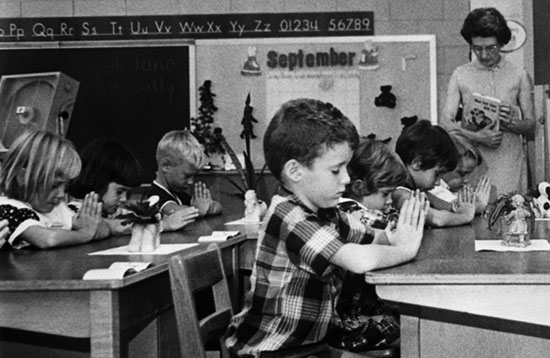
Engel v. Vitale, 1962: Can school officials (teachers, principals, etc) lead students in non-denominational prayer?
SCOTUS TEMPLATE

The prayer recited in New York that led to Engel v. Vitale:
Almighty God, we acknowledge our dependence upon Thee, and we beg Thy blessings upon us, our parents, our teachers and our country. Amen


Discuss the following example with your group:

Is it a prayer? (source: http://law2.umkc.edu/faculty/projects/ftrials/conlaw/estabinto.htm)
The following verse was read each day to a Florida kindergarten class.  The school board said the purpose of the verse was to calm kids down and create a sense of appreciation for the world.  Is the verse a prayer?  How are students likely to interpret "you"? Could "you" be Mother Nature or a Giant Slug?
We thank you for the flowers so sweet;
We thank you for the food we eat;
We thank you for the birds that sing;
We thank you for everything.


Wallace v. Jaffree, 1985: Can schools have a moment of silence for meditation/prayer?

Lee v. Weisman, 1992: Can schools have sponsored prayer (by a school official or religious figure) at graduation ceremonies?

Santa Fe Independent School District v. Doe, 2000: Can a popularly elected student representative lead students in prayer over the loudspeaker at a sporting event?


Could a student valedictorian lead her classmates in prayer at graduation? Discuss with your group if you think this violates the Establishment Clause. Are the free exercise of religion and freedom of speech rights in conflict with the Establishment Clause?


Epperson v. Arkansas, 1968 : Can a school ban the teaching of evolution?

Edwards v. Aguilard, 1987: Can a school require the teaching of creationism?

Westside v. Mergens, 1990: Can student religious groups meet on school grounds?

Is the Establishment Clause violated by allowing an optional Bible study class once a week for elementary and middle school students during school hours?

Is the Establishment Clause violated by allowing high school cheerleaders to put Bible verses on their banners at football games?


Religion and the Establishment Clause in Public Places

Lynch v. Donnelly, 1984: Can religious figures (i.e. Nativity scene) be part of a Christmas display on city property?

Stone v. Graham, 1980 & Van Orden v. Perry, 2004: Can the Ten Commandments be posted on government property?

Marsh v. Chambers, 1983 & Town of Greece, NY v. Galloway, 2014: Can legislative or town hall meetings begin with a prayer?

Do you think the city of Republic's city logo violates the Establishment Clause? Why or why not?


Other Establishment Clause Resources


3.1b Selective Incorporation

Announcements:
In addition to reading today's post, please make sure you:

  1. Complete the assigned Khan Academy modules over selective incorporation 
  2. Watch the video assigned through EdPuzzle (no questions)
  3. Complete the self-assessment on selective incorporation.
As always, email me if you have any questions or need help!


READING: 85-126 in Edwards


UNIT THREE Identification Terms 
________________________________________________

Today's Essential Question: What is selective incorporation and how does it affect individual liberties?

Learning Standards:
LOR-2.A: Explain how the U.S. Constitution protects individual liberties and rights.
LOR-2.B: Describe the rights protected in the Bill of Rights
LOR-2.A.1: The U.S. Constitution includes a Bill of Rights specifically designed to protect individual liberties and rights.
LOR-2.A.2: Civil liberties are constitutionally established guarantees and freedoms that protect citizens, opinions, and property against arbitrary government interference.
LOR-2.B.1: The Bill of Rights consists of the first ten Amendments to the Constitution, which enumerate the liberties and rights of individuals.


Today's Key Questions:
1. Does the Bill of Rights apply to the states or are they just protections from the federal government?
2. What is incorporation, sometimes referred to as selective incorporation?


1. Does the Bill of Rights apply to the states or are they just protections from the federal government? 
2. What is incorporation, sometimes referred to as selective incorporation?
The 1st Amendment begins, "Congress shall make no law respecting an establishment of religion..."  Does this mean that the Bill of Rights only protects you from the federal government or does it extend to protections from state governments as well? The Supreme Court first addressed this issue in the court case Barron v. Baltimore (1833). Read this case summary to see what the Marshall Court decided.

The passage of the 14th Amendment in 1870 radically changes the Constitution and its meaning however. Specifically, the due process clause prevents states from depriving citizens of their life, liberty, or property without due process of law. A series of court cases starting in the 20th century begins applying the Bill of Rights to the states, a process known as incorporation. Read about the 14th Amendment, due process, and selective incorporation here.

How do each of the following court cases relate to concept of incorporation? What right is being incorporated?
  • Gitlow v. New York, 1925
  • Near v. Minnesota, 1931
  • Mapp v. Ohio, 1961
  • Gideon v. Wainwright, 1963
  • McDonald v. Chicago, 2010
Review Videos:


3.1a Civil Liberties or Civil Rights?

Announcements:
Today, we will begin our remote learning and online instruction. Please make sure you read through today's post, clicking on (and reading!) the links on the differences between civil liberties and civil rights. In addition, please make sure you:

  1. Complete the three assigned Khan Academy modules on the Bill of Rights.
  2. Watch the Crash Course video and answer the two questions assigned through EdPuzzle.
  3. Check your understanding by taking this short quiz (also linked below).

As always, email me if you have any questions or need help!

READING: 85-126 in Edwards


UNIT THREE Identification Terms 
________________________________________________

Today's Question: What are the differences between civil liberties and civil rights? 

Learning Standards:
LOR-2.A: Explain how the U.S. Constitution protects individual liberties and rights.
LOR-2.B: Describe the rights protected in the Bill of Rights
LOR-2.A.1: The U.S. Constitution includes a Bill of Rights specifically designed to protect individual liberties and rights.
LOR-2.A.2: Civil liberties are constitutionally established guarantees and freedoms that protect citizens, opinions, and property against arbitrary government interference.
LOR-2.B.1: The Bill of Rights consists of the first ten Amendments to the Constitution, which enumerate the liberties and rights of individuals.

PRD-1.A.1: Civil rights protect individuals from discrimination based on characteristics such as race, national origin, religion, and sex; these rights are guaranteed to all citizens under the due process and equal protection clauses of the U.S. Constitution, as well as acts of Congress.


1. What's the difference between civil liberties and civil rights?
Unit Three focuses on civil liberties and civil rights. However, many students (and adults) do not understand the difference between these two topics.

Discuss with your table what you think are the differences between the civil rights and civil liberties. Next, see if your discussion was similar to these explanations of civil rights and liberties and the differences between them.

Check your understanding by taking this short quiz.

Review Videos