Showing posts with label religion. Show all posts

Monday, March 30, 2020

3.2b The First Amendment: Free Exercise Clause

Listen to the screencast of today's post here.

Announcements:
In addition to reading today's post, please make sure you:
  1. Read the Street Law summary of Wisconsin v. Yoder, one of the required SCOTUS cases
  2. Fill out the SCOTUS Required Cases Matrix for Wisconsin v. Yoder. (Use the same copy that you made for Engel v. Vitale and keep filling in as we cover additional cases)
  3. Complete assigned Khan Academy readings and self-quiz on the Free Exercise Clause.
  4. Outline of everything is on our weekly planner.

Similar to the post on the Establishment Clause, today's lesson has quite a few court cases. The only case that is required by the College Board is Wisconsin v. Yoder, but I have included the others to show you how the courts have handled different issues of protecting people's religious liberties vs. government regulation and restrictions. Please make sure you understand the differences between cases that are Establishment Clause-based (government endorsement or promotion of religion) vs. Free Exercise cases (government restriction on personal religious freedoms).

As always, email me if you have any questions or need help!

READING: 85-126 in Edwards


______________________________________________________

Today's Essential Question: How does the government effectively interpret and balance religious freedom and practice with respect to the First Amendment?

Learning Standards:


LOR-2.C: Explain the extent to which the Supreme Court’s interpretation of the First and Second Amendments reflects a commitment to individual liberty.
LOR-2.C.1: The interpretation and application of the First Amendment’s establishment and free exercise clauses reflect an ongoing debate over balancing majoritarian religions practice and free exercise, as represented by such cases as:
  • Engel v. Vitale (1962), which declared school sponsorship of religious activities violates the establishment clause 
  • Wisconsin v. Yoder (1972), which held that compelling Amish students to attend school past the eighth grade violates the free exercise clause 

Free Exercise Clause

The First Amendment's Establishment Clause prevents government endorsement of religion, but the Free Exercise Clause guarantees your right to believe in whatever religion (or none at all) without restriction. However, government may restrict action based on those beliefs if it violates the law or infringes on the rights of others. Just like other rights, it is not absolute.Today, we will look at a few issues involving the free exercise of religion.

Reynolds v. US, 1879: One of the first cases involving the free exercise clause involved the Mormon Church and the practice of polygamy. Can someone have multiple spouses if it is part of their religious beliefs?

Wisconsin v. Yoder, 1972: Another famous free exercise case involved whether or not Amish families could be exempt from a state law that required all children to attend school until the age of 16.

Other free exercise of religion questions:

Should people be able to claim religious exemptions for mandatory vaccinations?

Can states ban the practice of snake-handling for religious purposes?

Employment Division v. Smith: Can a state deny unemployment benefits if a person was fired for illegal drug use, even if that drug use (peyote) was part of a religious ceremony?

West Virginia v. Barnette, 1943: Can a state compel people to recite the pledge of allegiance, even if it goes against their religious beliefs?

Church of Lukumi Babalu Aye v. Hialeah, 1993: Are ritualistic animal sacrifices protected under the free exercise clause?

Can a Pastafarian wear a colander on his head for his driver's license photo?


Discuss the following scenario:

George Daniels was fired in 1998 for wearing a small gold cross on his uniform collar. Daniels, an evangelical Christian and 14-year decorated sergeant, had been twice ordered to stop wearing the pin. He began wearing it when he was a plainclothes officer. The Arlington Police Department said the agency's interest in maintaining a public appearance of impartiality outweighed Daniels' right to promote his Christianity.

How should the courts rule in this case?


Bottom Line: Government may not restrict religious beliefs, but may limit your actions.


Review Videos:


Tuesday, March 24, 2020

3.2 The First Amendment: The Establishment Clause

Listen to the screencast of today's post.

Announcements:
In addition to reading today's post, please make sure you:

  1. Read the Street Law summary of Engel v. Vitale, one of the required SCOTUS cases
  2. Fill out the SCOTUS Required Cases Matrix for Engel v. Vitale
  3. Complete the Flipgrid (check your email for instructions and link) on the Establishment Clause.
As you look at today's post, you will see there are quite a few court cases. Like an excessive amount. The only case that is required by the College Board is Engel v. Vitale, but I have included the others to show you how often the Establishment Clause comes up in a variety of situations, most commonly involving public schools and religion. The most important thing is that you understand what the Establishment Clause means (based on the Court's interpretation over the last 50+years) and how it continues to be litigated and debated today.

As always, email me if you have any questions or need help!


READING: 85-126 in Edwards


READING: 85-126 in Edwards


UNIT THREE Identification Terms 
________________________________________________

Today's Essential Question: How does the government effectively interpret and balance religious freedom and practice with respect to the First Amendment?

Learning Standards:


LOR-2.C: Explain the extent to which the Supreme Court’s interpretation of the First and Second Amendments reflects a commitment to individual liberty.
LOR-2.C.1: The interpretation and application of the First Amendment’s establishment and free exercise clauses reflect an ongoing debate over balancing majoritarian religions practice and free exercise, as represented by such cases as:
  • Engel v. Vitale (1962), which declared school sponsorship of religious activities violates the establishment clause 
  • Wisconsin v. Yoder (1972), which held that compelling Amish students to attend school past the eighth grade violates the free exercise clause 

________________________________________________


The Establishment Clause
The 1st Amendment protects five basic freedoms: speech, religion, press, right to petition, and the right to assemble. However, freedom of religion is a little more nuanced and actually contains two clauses related to religion.

"Congress shall make no law respecting an establishment of religion, or prohibit the free exercise thereof..."

The clause in red is referred to as the Establishment Clause and the one in blue is called the Free Exercise Clause. Today's focus is on the difference between these two clauses dealing with freedom of religion.

Discuss with your group what you think the Establishment Clause means. Does it prohibit strictly a national religion or does it mean there should be no endorsement or favoritism towards a specific religion or religion in general? How is religion part of American life and government? What is meant by the separation between church and state?


Many of the Court's decisions about the Establishment Clause involve religion in schools. Here are some of the important cases. Must-know cases are in larger font.

Religion and the Establishment Clause in School

Everson v. Board of Education, 1947: Can parents of students attending a private school (i.e. St. James or Pius) be reimbursed for transportation (busing) costs for students?

Lemon v. Kurtzman, 1971: What can private/religious schools be reimbursed for? 

The Lemon Test: 
1. Does it serve a religious purpose?
2. Does it create excessive entanglement?
3. Does it have a primary purpose of advancing or inhibiting religion?

Which of the following passes the Lemon Test?
  • math textbooks
  • state mandated tests
  • field trips
  • teacher salary
  • interpreter for a deaf student
  • free/reduced lunch program


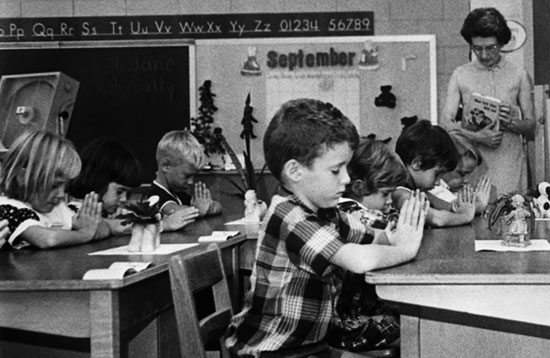
Engel v. Vitale, 1962: Can school officials (teachers, principals, etc) lead students in non-denominational prayer?
SCOTUS TEMPLATE

The prayer recited in New York that led to Engel v. Vitale:
Almighty God, we acknowledge our dependence upon Thee, and we beg Thy blessings upon us, our parents, our teachers and our country. Amen


Discuss the following example with your group:

Is it a prayer? (source: http://law2.umkc.edu/faculty/projects/ftrials/conlaw/estabinto.htm)
The following verse was read each day to a Florida kindergarten class.  The school board said the purpose of the verse was to calm kids down and create a sense of appreciation for the world.  Is the verse a prayer?  How are students likely to interpret "you"? Could "you" be Mother Nature or a Giant Slug?
We thank you for the flowers so sweet;
We thank you for the food we eat;
We thank you for the birds that sing;
We thank you for everything.


Wallace v. Jaffree, 1985: Can schools have a moment of silence for meditation/prayer?

Lee v. Weisman, 1992: Can schools have sponsored prayer (by a school official or religious figure) at graduation ceremonies?

Santa Fe Independent School District v. Doe, 2000: Can a popularly elected student representative lead students in prayer over the loudspeaker at a sporting event?


Could a student valedictorian lead her classmates in prayer at graduation? Discuss with your group if you think this violates the Establishment Clause. Are the free exercise of religion and freedom of speech rights in conflict with the Establishment Clause?


Epperson v. Arkansas, 1968 : Can a school ban the teaching of evolution?

Edwards v. Aguilard, 1987: Can a school require the teaching of creationism?

Westside v. Mergens, 1990: Can student religious groups meet on school grounds?

Is the Establishment Clause violated by allowing an optional Bible study class once a week for elementary and middle school students during school hours?

Is the Establishment Clause violated by allowing high school cheerleaders to put Bible verses on their banners at football games?


Religion and the Establishment Clause in Public Places

Lynch v. Donnelly, 1984: Can religious figures (i.e. Nativity scene) be part of a Christmas display on city property?

Stone v. Graham, 1980 & Van Orden v. Perry, 2004: Can the Ten Commandments be posted on government property?

Marsh v. Chambers, 1983 & Town of Greece, NY v. Galloway, 2014: Can legislative or town hall meetings begin with a prayer?

Do you think the city of Republic's city logo violates the Establishment Clause? Why or why not?


Other Establishment Clause Resources