Monday, April 27, 2020

Letter From Birmingham Jail

Announcements:

In addition to reading today's post, please make sure you:
  1. Read Letter from a Birmingham Jail and annotate. This is one of the foundational documents for the AP exam.
  2. Complete the Khan Academy modules on Letter from a Birmingham Jail.


READING: 129-159 in Edwards

Today's Essential Question: How did non-violent protests affect the civil rights movement?

Learning Standards:

PRD-1.A.2: The leadership and events associated with civil, women’s, and LGBTQ rights are evidence of how the equal protection clause can support and motivate social movements, as represented by:

  • Dr. Martin Luther King’s “Letter from a Birmingham Jail” and the civil rights movement of the 1960s 
  • The National Organization for Women and the women’s rights movement 
  • The pro-life (anti-abortion) movement

Letter from Birmingham Jail
One of the most notable documents of the 20th century is Dr. Martin Luther King's Letter from Birmingham Jail, a response to criticisms from local clergymen. 

  • Read the initial letter (linked above) addressed to Dr. King. What is their concern/criticism? Do you think it is a valid criticism?
  • Read Letter from Birmingham Jail.  Make a copy for yourself and annotate as you read. Select three quotes that you think are most significant and highlight them. Also, be prepared to discuss the questions listed below:

1. Briefly, what is the argument of the "Statement by Alabama Clergymen"?
2. What reasons does King provide for his decision to support direct action or demonstrations against segregation in Alabama?
3. What are justice and injustice according to King?
4. What kinds of law does King speak about in this letter, and what is their applicability in terms of political life?
5. What kind of moderation is King criticizing, and what kind of extremism is he praising?
6. According to King, what is the role of the church and organized religion in contemporary society?
7. What did King mean when he wrote, "But now I must affirm that it is just as wrong, or perhaps even more so, to use moral means to preserve immoral ends"?
8. Is King's argument sound? Explain your answer.



Friday, April 24, 2020

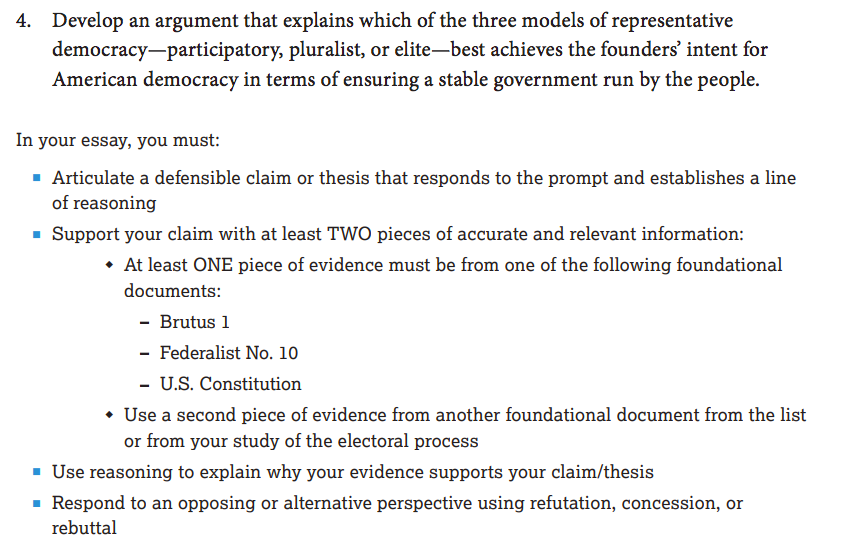
AP Exam Review 4/24 (Argumentative Essay)

Announcements:

AP Exam: Monday, May 11th @3:00pm

Review material resources--Remember that this test is only over units 1-3 and will consist of just 2 FRQ questions. (Concept Application and Argumentative Essay)

McGraw Hill is allowing their study guide, 5 Steps to a 5 free of charge due to the unique situation. To access their material please follow these directions:

2. Select "Redeem Access Code" and enter your voucher/access code (listed below)
3. Then you'll be prompted to sign up with your name and email address. Now you're all set to use the platform.
4. Access code--mhapgwph337


Also, use Khan Academy modules, videos, and quizzes.

The Test Explained
Foundational Documents Summaries
Supreme Court Cases Cheat Sheet
Required Court Case Cheat Sheet 
Quizlet Sets


The Argumentative Essay FRQ
Today we are going to look at how to write an effective Argumentative FRQ and maximize your points on this question.

The rubric has slightly changed for the 2020 exam. Knowing how you will be scored on the essay is essential to writing an effective response. Take a few minutes and read through the revised FRQ4 rubrics released by the College Board.

You can also look at these teacher generated rubrics here and here. They may be easier to understand.

Use this template to structure your argumentative essay.


Here is a sample argumentative essay FRQ:


Here are a few videos that explain how to write the Argumentative Essay FRQ. The first two are specific for the 2020 exam. Watch these! We will begin practicing writing these questions next week.


Monday, April 20, 2020

Civil Rights and Legislation

Announcements:
In addition to reading today's post, please make sure you:
  1. Complete the Khan Academy modules on balancing majority and minority rights (video, article, 4 question self-check)


READING: 129-159 in Edwards


Today's Question: How has Congress impacted civil rights and the push for equality?

Learning Standards:

PMI-3.A: Explain how the government has responded to social movements.
PMI-3.A.1: The government can respond to social movements through court rulings and/or policies, as in:
  • Brown v. Board of Education (1954), which declared that race-based school segregation violates the Fourteenth Amendment’s equal protection clause 
  • The Civil Rights Act of 1964 
  • Title IX of the Education Amendments Act of 1972 
  • The Voting Rights Act of 1965

CON-6.A: Explain how the Supreme Court has at times allowed the restriction of the civil rights of minority groups and at other times has protected those rights.

CON-6.A.1: Decisions demonstrating that minority rights have been restricted at times and protected at other times include:
  • State laws and Supreme Court holdings restricting African American access to the same restaurants, hotels, schools, etc., as the majority white population based on the “separate but equal” doctrine 
  • Brown v. Board of Education (1954), which declared that race-based school segregation violates the Fourteenth Amendment’s equal protection clause 
  • The Supreme Court upholding the rights of the majority in cases that limit and prohibit majority-minority districting 

Civil Rights & Congress
In addition to finding remedy in the courts, civil rights legislation has also helped promote equality. Today, we will examine several of the more important acts and look at the impact they have had.

Perhaps the most significant piece of civil rights legislation passed by Congress is the 1964 Civil Rights Act. Read this CNN article on the 50th anniversary of the bill's passage.


Major Provisions of the 1964 Civil Rights Act:

1.Banned discrimination in places of public accommodation based on race, color, religion, sex, or national origin.

2. Banned discrimination in employment based on race, color, religion, sex, or national origin.

3. Tied federal funding for public schools to compliance with Brown v. Board.

4. Created the Equal Employment Opportunity Commission (EEOC) to help investigate and file lawsuits based on discrimination.

5. Banned federal funds to any government assisted program that discriminates.


Heart of Atlanta Motel v. US, 1964: upholds Congress's ability to prohibit discrimination based on the interstate commerce clause.


As important and comprehensive as the 1964 Civil Rights Act was, it did not go far enough to protect voting rights for African Americans. This was remedied a year later with passage of the 1965 Voting Rights Act.

Major Provisions of the 1965 Voting Rights Act:
1. Prohibits any form of literacy tests.

2. Allows federal examiners (government officials) to help with voter registration and monitor elections

3. A "pre-clearance" from the Justice Department on any changes that might discriminate against voters (weakened in Shelby County v. Holder, 2013)


Was the 1965 Voting Rights Act successful?


In Shelby County v. Holder, the Supreme Court limited Section V of the 1965 Voting Rights Act.


What impact did the 1964 CRA and 1965 VRA have on political parties?

Do current proposals requiring photo identification for voting limit voting rights?


Other important pieces of legislation:

Title IX of the Educational Act of 1972: prohibits any form of sexual discrimination or sexual harassment in education; most common controversy involves athletics and gender equity

Americans with Disabilities Act (ADA) of 1990: modeled after the 1964 CRA, the ADA prohibits discrimination based on mental or physical disabilities and promotes equality of opportunity. Criticized as an unfunded mandate and a source of excessive litigation.

Defense of Marriage Act (DOMA) of 1996: prohibits federal government from recognizing same-sex marriages performed at the state level; struck down in US v. Windsor, 2013.

Civil Rights & the Courts (2 days)

Announcements:


In addition to reading (and watching the screencast) today's post, please make sure you:
  1. Read the Street Law Summary of Brown v. Board of Education.
  2. Fill in the information about this case on the Supreme Court case matrix (use the same copy you have been using)
  3. Complete the Khan Academy modules on government responses to social movements (Brown v. Board video, article, and 4 question self-check)


READING: 129-159 in Edwards

Today's Question: How has the Supreme Court impacted civil rights and the push for equality?

Learning Standards:
PMI-3.A: Explain how the government has responded to social movements.
PMI-3.A.1: The government can respond to social movements through court rulings and/or policies, as in:

  • Brown v. Board of Education (1954), which declared that race-based school segregation violates the Fourteenth Amendment’s equal protection clause 
  • The Civil Rights Act of 1964 
  • Title IX of the Education Amendments Act of 1972 
  • The Voting Rights Act of 1965


CON-6.A: Explain how the Supreme Court has at times allowed the restriction of the civil rights of minority groups and at other times has protected those rights.

CON-6.A.1: Decisions demonstrating that minority rights have been restricted at times and protected at other times include:

  • State laws and Supreme Court holdings restricting African American access to the same restaurants, hotels, schools, etc., as the majority white population based on the “separate but equal” doctrine 
  • Brown v. Board of Education (1954), which declared that race-based school segregation violates the Fourteenth Amendment’s equal protection clause 
  • The Supreme Court upholding the rights of the majority in cases that limit and prohibit majority-minority districting 


Review:
  • What is the difference between civil liberties and civil rights?
  • What is incorporation? How does it work?
  • What is the difference between the Free Exercise Clause and the Establishment Clause? Provide an example of each.
  • What is meant by the "clear and present danger" doctrine?
  • What is the significance of Mapp v. Ohio?
  • What two court cases helped incorporate provisions of the 5th & 6th Amendments?
  • How does the right to privacy illustrate judicial activism?


Civil Rights and the Courts
The courts have played a vital role in the promotion of civil rights, especially in the latter 20th century and 21st century. Interest groups, like the NAACP, have successfully litigated in support of civil rights with landmark decisions like Brown v. Board of Education. The Fourteenth Amendment's Equal Protection Clause ("no state shall deny to any person under its jurisdiction equal protection under the law") is most commonly used as the legal justification for these civil rights cases.


Review Videos:


Important Civil Rights Cases:

Plessy v. Ferguson

Brown v. Board of Education, 1954

Brown v. Board of Education II, 1955

Heart of Atlanta Motel v. US, 1964

Swann v. Charlotte-Mecklenburg, 1971

Regents of the University of California v. Bakke, 1978

US v. Windsor, 2013

Obergefell v. Hodges, 2015


The Right to Privacy

Announcements:
In addition to reading (and watching the screencast) today's post, please make sure you:
  1. Read the Street Law Summary on Roe v. Wade
  2. Fill in the information about this case on the Supreme Court case matrix (use the same copy you have been using)

READING: 85-126 in Edwards


Today's Question: How does the government effectively balance the right to privacy with the need to maintain order?


Learning Standards:
LOR-3.B.5: While a right to privacy is not explicitly named in the Constitution, the Supreme Court has interpreted the due process clause to protect the right of privacy from state infringement. This interpretation of the due process clause has been the subject of controversy, such as has resulted from:
  • Roe v. Wade (1973), which extended the right of privacy to a woman’s decision to have an abortion while recognizing compelling state interests in potential life and maternal health

Right to Privacy

Does the right to privacy exist? What amendment guarantees your right to privacy?

There are several important cases related to the issue of privacy rights and individual liberties. One of the most important cases is Griswold v. Connecticut (1965). In this case, Estelle Griswold of Planned Parenthood was prosecuted for distributing birth control pills, prohibited by Connecticut law, even to married couples. Click on the above link to read about the case. What is meant by penumbra?

Griswold is considered a landmark decision by establishing a right to privacy. This serves as a springboard to other privacy cases, most notably the case Roe v. Wade (1973) and other court decisions involving abortion rights and attempts to limit and regulate abortions. Read this summary of Roe v. Wade. Why is Roe v. Wade so significant? What did it specifically do?

Roe v. Wade was just the beginning of legal challenges concerning abortion. Since 1973, states have repeatedly passed legislation to limit abortions. The Court has maintained the right to an abortion, but has gradually upheld state and federal restrictions during the last forty years. Some of the restrictions include:

Missouri has one of the most restrictive abortion laws in the country, requiring a 72-hour waiting period.  Missouri has also increased its restrictive health regulations, threatening to shut down Missouri's only abortion provider (Planned Parenthood in St. Louis). Missouri would become the 1st state without any abortion access.

Can a state require abortion clinics to have surgical facilities and doctors with admitting privileges at local hospitals?


Other Privacy Issues

Forced sterilization: Buck v. Bell (1927) and Skinner v. Oklahoma

Right to Marry: Loving v. Virginia, 1967

Right to Die: Cruzan v. Missouri Dept. of Health, 1990

Sexual Behavior: Lawrence v. Texas, 2003

How do the Lawrence v. Texas and Loving v. Virginia cases affect the Supreme Court's decision regarding same-sex marriage?

Review Videos


Thursday, April 16, 2020

The 8th Amendment

Announcements:
In addition to reading today's post, please make sure you:
  1. Complete the assigned Khan Academy module on the 8th Amendment
  2. Complete the assigned Khan Academy Civil Liberties Quiz #2. Keep attempting until you score at least 80%!
  3. Study for Civil Liberties Amendments 2-8 Quiz on Friday

READING: 85-126 in Edwards


Today's Essential Question: Does the death penalty violate the 8th Amendment’s prohibition on cruel and unusual punishment?


Learning Standards:
LOR-2.D: Explain how the Supreme Court has attempted to balance claims of individual freedom with laws and enforcement procedures that promote public order and safety.

LOR-2.D.1: Court decisions defining cruel and unusual punishment involve interpretation of the Eighth Amendment and its application to state death penalty statutes over time. 

Eighth Amendment 

Two main provisions:
  • No cruel & unusual punishment
  • No excessive fines or bail
Most relevant issues involve use of the death penalty.

Furman v. Georgia, 1972: Death penalty was being unfairly applied (too random/arbitrary); puts a temporary moratorium on it

Gregg v. Georgia, 1976: reinstates the death penalty; provides more guidance to jurors

Other issues:
Death penalty for mentally challenged? Minors?


Review your civil liberties: Play the game Do I Have a Right  by iCivics. Pretend to be a lawyer and build up your law firm helping people with their complaints.

Review Videos:


Wednesday, April 15, 2020

3.8 Amendments: Due Process and the Rights of the Accused

Announcements:

Welcome to another week of online learning! It looks like the Missouri Constitution test was a success and you have cleared that hurdle towards graduation. This week, we will continue our examination of civil liberties, specifically looking at Amendments 2-8. Like past weeks, this will consist of daily posts, Khan Academy modules, videos, and multiple Supreme Court cases. You can find our weekly planner here. Remember that posts are in reverse order.

Please continue to stay on top of the content as all of this material is part of Unit 3 which will be tested on the AP exam on May 11th.

In addition to reading today's post, please make sure you:
  1. Read the Street Law summary on Gideon v. Wainwright (required case).
  2. Fill in the information about this case on the Supreme Court case matrix (use the same copy you have been using)
  3. Watch the Khan Academy videos on the 5th & 6th Amendments
  4. Complete the self-assessment on Rights of the Accused
  5. Google Meet Optional check-in to ask questions and clarify any concepts. Join either one of our meeting times at 10:30am or 1:00pm (see weekly planner for links)
READING: 85-126 in Edwards


Today's Essential Question: How does the government effectively balance the 5th and 6th Amendments’ rights of the accused with the need to maintain social order?


Learning Standards:
LOR-2.D: Explain how the Supreme Court has attempted to balance claims of individual freedom with laws and enforcement procedures that promote public order and safety.

LOR-3.B.2: The Miranda rule involves the interpretation and application of accused persons’ due process rights as protected by the Fifth and Sixth Amendments, yet the Supreme Court has sanctioned a public safety exception that allows unwarned interrogation to stand as direct evidence in court. 

LOR-3.B.3: Pretrial rights of the accused and the prohibition of unreasonable searches and seizures are intended to ensure that citizen liberties are not eclipsed by the need for social order and security, including: 
  1. The right to legal counsel, a speedy and public trial, and an impartial jury 
  2. Protection against warrantless searches of cell phone data under the Fourth Amendment 
  3. Limitations placed on bulk collection of telecommunication metadata (Patriot and USA Freedom Acts)

LOR-3.B.4: The due process clause has been applied to guarantee the right to an attorney and protection from unreasonable searches and seizures, as represented by: 
  1. Gideon v. Wainwright (1963), which guaranteed the right to an attorney for the poor or indigent 
  2. The exclusionary rule, which stipulates that evidence illegally seized by law enforcement officers in violation of the suspect’s Fourth Amendment right to be free from unreasonable searches and seizures cannot be used against that suspect in criminal prosecution

Rights of the Accused

Similar to the 4th Amendment and the protection of unwarranted searches, the government must balance the rights of the individuals and those accused of a crime with the need to maintain order and promote public safety. The various rights expressed in both the 5th and 6th Amendments were seen as essential in the early days of the republic and were rooted in grievances against prior English practices. In the 20th century, many of these rights were incorporated at the state level through a series of court decisions, most notably Gideon v. Wainwright and Miranda v. Arizona.


Review Videos: